The journey so far
On November 30, 2022, OpenAI released ChatGPT to the public. In less than a week, it had over one million users. Within two months, over 100 million people were using it. This wasn't just another tech product launch. It was the moment artificial intelligence entered the mainstream conversation.
Now, another shift is underway that is arguably bigger than the first: AI agents. The chatbot era was about asking questions and getting intelligent answers. The agent era is about giving goals and getting outcomes. Instead of typing a question and reading a response, you describe what you want done and an AI agent goes and does it. It can open files, browse the web, write and send emails, build documents, and work through multi-step tasks without you managing every step. That distinction matters more than most people realize.
The money behind this moment tells you everything you need to know about how seriously the world is taking it. In 2026, total global AI investment is expected to exceed $650 billion for the year. That includes the massive data center buildouts from Microsoft, Google, Meta, and Amazon, hundreds of billions in venture capital flowing into AI startups, and significant government spending on AI research and national competitiveness initiatives. This is not speculative capital chasing hype. This is the largest coordinated technology investment in history, and it is accelerating.
The main AI trends in 2026
What makes AI uniquely transformative is that we're not experiencing just one wave of innovation. We're experiencing multiple overlapping waves, each building on the last:
- Wave 1: Chatbots — the ChatGPT era. Conversational AI that can write, reason, and answer questions. Maturing fast.
- Wave 2: AI agents — AI that can take action, not just respond. It can browse the web, read your files, send emails, and complete multi-step tasks on your behalf. Early acceleration phase.
Wave 1: Large language models & chat interfaces (maturing)
This is the wave most people are familiar with. ChatGPT, Gemini, Claude, Grok, and other conversational AI systems have moved from experimental to essential. Today in January 2026, these tools are:
- Multimodal: They can process text, images, audio, and video
- Context-aware: They maintain longer conversations and understand nuance
- Specialized: Models fine-tuned for specific industries and use cases
- Accessible: Available through simple chat interfaces, applications, and API integrations
Where we are: The steep growth phase has begun to plateau for chat interfaces. The focus now is on refinement, reliability, and specialized applications rather than raw capability expansion (though large investments are continuing from the major providers).
What this means for you: If you're not using AI yet, now is a good time to start thinking about where it might actually help you — whether in your job, your personal projects, or just your day-to-day life. And if you're already using it, the focus shifts to using it more effectively. Our SMART Prompting Guide is a good place to start for getting noticeably better results out of any AI tool.
Wave 2: AI agents (early acceleration)
This is where things get really interesting. Classic chat bots are like a drop in the ocean compared to the potential that AI Agents offer. We're moving beyond AI as a conversational partner to AI as an autonomous worker. These agents can:
- Execute multi-step tasks without constant supervision
- Make decisions based on context and goals
- Interact with multiple tools and systems
- Learn from feedback and improve over time
Real-world examples in early 2026:
Claude Cowork: Branded as "Claude Code for the rest of your work." Cowork brings the same autonomous, agent-style workflow to non-developers. It can read your local files, create documents, synthesize research, organize folders, and execute multi-step tasks, all from a visual interface. If Claude Code proved agents could write software, Cowork is proving they can handle everyday knowledge work.
What's coming next: Google, OpenAI, Microsoft, Grok, and others are all racing to release their own general-purpose agent capabilities. Expect major announcements throughout 2026 as every major AI lab works to move beyond chat interfaces into autonomous agents that can operate across your entire computer.
What this means for you: The nature of knowledge work is changing fast. Tasks that once took hours can now be delegated to agents. They'll be able to work 24/7 on your behalf, given proper direction. The valuable skill is knowing how to direct, supervise, and leverage these agents effectively. You may be wondering how to get your hands on one of these agents today. AInalysis is here to help. Start with our intro to AI agents guides to get up to speed.
"Something big is happening"
If the points in this article resonate with you, you're not alone. In February 2026, AI founder and investor Matt Shumer published a 5,000-word essay on X titled "Something Big Is Happening" that echoes many of the same themes we've covered here, and it struck a massive nerve. The post has surpassed 82 million views and sparked a global conversation.
Whether or not you agree with every point Shumer makes, the essay is a worthwhile read that reinforces the urgency of everything we've discussed. It's one of the most widely-read pieces on AI's near-term impact, and for good reason.
Shumer describes the moment that GPT-5.3 Codex and Claude Opus 4.6 dropped on the same day and something "clicked" for him. He compares the current AI moment to February 2020, when COVID was already spreading but most people hadn't yet grasped what was coming. His core message: the water is rising, and it's already at your chest.
His key arguments align closely with what we've outlined above:
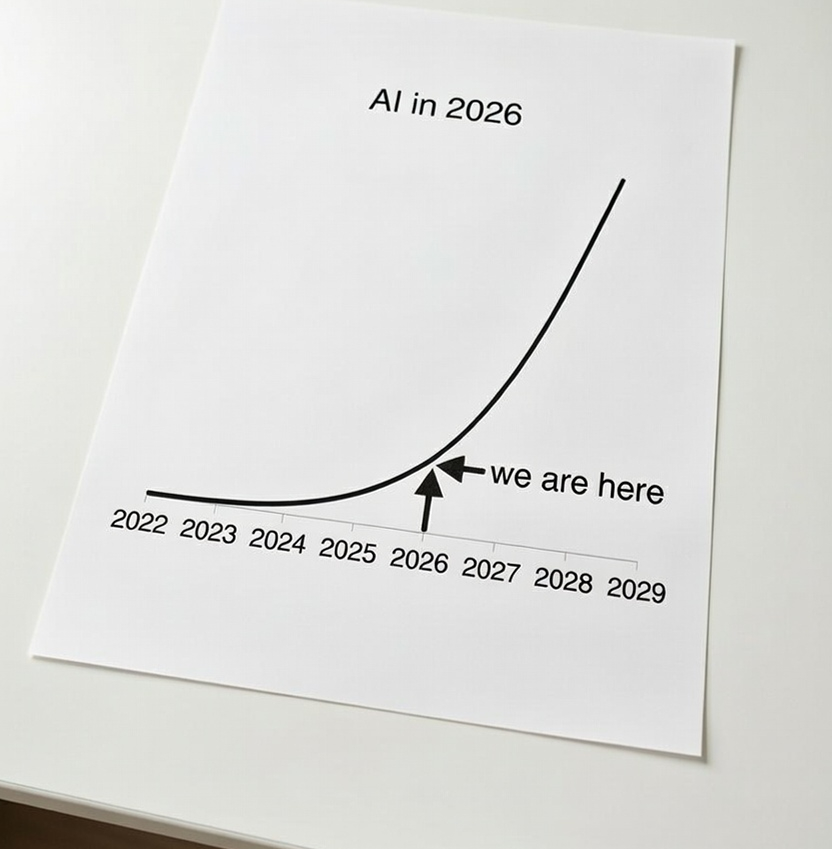
- AI isn't improving incrementally anymore. It went from failing basic math (2022) to passing the bar exam (2023) to handling graduate-level work (2024). The trajectory is exponential.
- 50% of entry-level white-collar jobs could disappear within 1-5 years. Unlike past automation that targeted single skills, AI is improving across all cognitive domains simultaneously.
- AI is now building itself. OpenAI disclosed that GPT-5.3 helped create itself, a feedback loop researchers call an "intelligence explosion."
- The window to adapt is still open, but it's closing. Those who start seriously experimenting now will have a massive head start.
Why this technology matters more than any before
Many claim AI is "the most important technology humans have created." Here's why they might be right:
- It's General: Unlike previous technologies that excelled at specific tasks, AI is increasingly capable across all cognitive domains
- It Scales Instantly: Once developed, AI capabilities can be deployed to billions of people immediately
- It Compounds: AI is being used to develop better AI, creating exponential improvement
The IQ Leap: Albert Einstein, the gold standard for human genius, had an estimated IQ of approximately 160. As of early 2026, top-tier frontier models are already consistently scoring in the 140–150 range on standardized reasoning tests. We are currently standing on the doorstep of "human genius" as a baseline.
But here is the differentiator, Einstein was one man. AI is a utility. Imagine if, by next week, you could "summon" a million digital Einsteins to solve a single problem. This isn't just a productivity boost; it’s a phase shift in human capability. And unlike biological brains, AI doesn't have a physical ceiling. We are on a trajectory where AI IQ will likely move through 200, 500, and eventually 1,000+.
When you can summon that level of intelligence instantly, at scale, the traditional economy, which is built on the scarcity of labor and human expertise, starts to look very different.
Most businesses are experimenting, not adopting
Every year, McKinsey publishes its State of AI report — one of the most comprehensive surveys of how organizations around the world are actually using AI. The 2025 edition surveyed thousands of executives and business leaders globally, and the headline finding is striking: 88% of organizations are using AI in at least one business function. Nearly universal.
But dig one level deeper and a very different picture emerges. Of those 88%, only 7% have fully scaled AI across their organization. Two-thirds are still in the pilot or proof-of-concept stage, with no clear plan to move beyond it.
Most businesses have dipped their toes in the water. Very few have learned to swim.
This gap matters because the companies that are actually scaling AI, not just experimenting with it, are starting to pull ahead. They are closing faster, operating leaner, and doing in days what used to take weeks. The window between "we tried a pilot" and "we run on AI" is where competitive advantage is being built or lost right now.
The same pattern holds for individuals. Most people have tried ChatGPT. Far fewer have figured out how to weave AI into their daily work in a way that actually changes what they're capable of. That is exactly what AInalysis is here to help with.
The investment landscape
The money flowing into AI is staggering and unprecedented. The four major hyperscalers alone — Amazon, Google, Meta, and Microsoft — are on track to spend over $650 billion combined in capital expenditure in 2026, a 36% increase over 2025 and roughly double what they spent in 2024. To put that in perspective:
- Amazon: ~$200 billion in projected 2026 capex, predominantly for AI data centers
- Google (Alphabet): ~$75 billion committed for 2026, up from $52 billion in 2024
- Meta: ~$65 billion planned for 2026, almost entirely AI infrastructure
- Microsoft: ~$80 billion committed for the fiscal year, building out AI compute globally
Around 75% of this combined spend is going directly to AI infrastructure: GPUs, data centers, and the networking required to run frontier models at scale. Beyond the hyperscalers, AI startups raised over $100 billion in venture capital in 2025 alone, and major governments are committing tens of billions more to national AI initiatives.
We don't think this is a bubble waiting to burst. It is a fundamental transformation of the technological foundation of modern civilization.
How to prepare: practical steps for 2026
1. Start using AI daily
If you're not using AI tools every single day, start now. Pick one task you do regularly and figure out how AI can help.
2. Learn prompt engineering
The ability to communicate effectively with AI is becoming as important as literacy. Take time to learn how to craft effective prompts. Check out our SMART Prompting Guide for a structured approach to AI interaction.
3. Understand your domain's AI tools
Most professions now have AI tools available. Find them. Learn them. Master them.
4. Focus on uniquely human skills
- Complex judgment in ambiguous situations
- Creative synthesis of disparate ideas
- Emotional intelligence and relationship building
- Strategic thinking and vision setting
5. Stay informed
AI is evolving monthly. Follow developments. Experiment with new tools. The gap between those who keep up and those who don't is widening rapidly.
6. Think in terms of AI leverage
Stop thinking "How do I do this task?" Start thinking "How can AI help me do this task 10x faster or better?"
Yes, AI is disruptive. Yes, it's changing everything. But here's something to remember:
We are still in the early stages of all of this.
The people who adapt now, in 2026, will have years of experience when the technology becomes truly mature. They'll understand how to work with AI agents and know how to get the most leverage out of them in their job or business.
The question isn't whether AI will reshape your work and life. It will. The question is: Will you be ready?
Our predictions (take with a grain of salt)
These are the opinions of the AInalysis team, not facts. AI is moving so fast that literally anything can happen. With that said, here is what we think is coming.
General purpose AI agents will become mainstream by the end of 2026. Right now, the most capable AI agents require some technical know-how to set up and use. That is changing fast. We think that by the end of this year, every major AI lab will have a general purpose agent that anyone can pick up and use without any technical background. Not just coders. Not just tech people. Everyone. Think of these agents as knowledge workers that live in your computer. They will start quietly weaving their way into how people do their jobs, handle their email, manage their schedules, do their research, and produce their work. We are writing this in March 2026 and genuinely believe the agent landscape by December 2026 will be unrecognizable compared to today. The pace is that fast.
Humanoid robotics will start to turn heads. This one is further out, but it is coming. We think the next year or two will bring a wave of videos that stop you in your tracks. You will watch a clip of something moving through a kitchen, folding laundry, or loading boxes in a warehouse, and for a second you will think it is a person. Then you will realize it is a robot. These are not the clunky, falling-over robots of ten years ago. The AI powering these machines has improved dramatically, and the physical hardware is catching up. We are still a few years from humanoid robots being a meaningful part of everyday life, but the demos you will see in 2026 and 2027 will make that future feel a lot closer than it does today.
What we covered: the state of AI in 2026
This has been a wide-ranging look at where AI stands right now, so here is the short version.
AI entered the mainstream with ChatGPT in late 2022 and has been moving fast ever since. We are now in a second, arguably bigger shift from chatbots to agents. Where chatbots answer questions, agents complete tasks. That distinction is going to matter a lot in the coming years.
The investment backing all of this is historic. The four major hyperscalers are on pace to spend over $650 billion combined in 2026 alone. This is not hype money. It is infrastructure.
Most businesses and individuals have tried AI in some form. Very few have integrated it in a way that actually changes how they operate. That gap is where the opportunity lives right now.
AI is not going to stay neatly inside a chat window. It is moving into every workflow, every profession, and eventually into the physical world. The people who start building real habits around it now will have a significant head start when it becomes unavoidable.